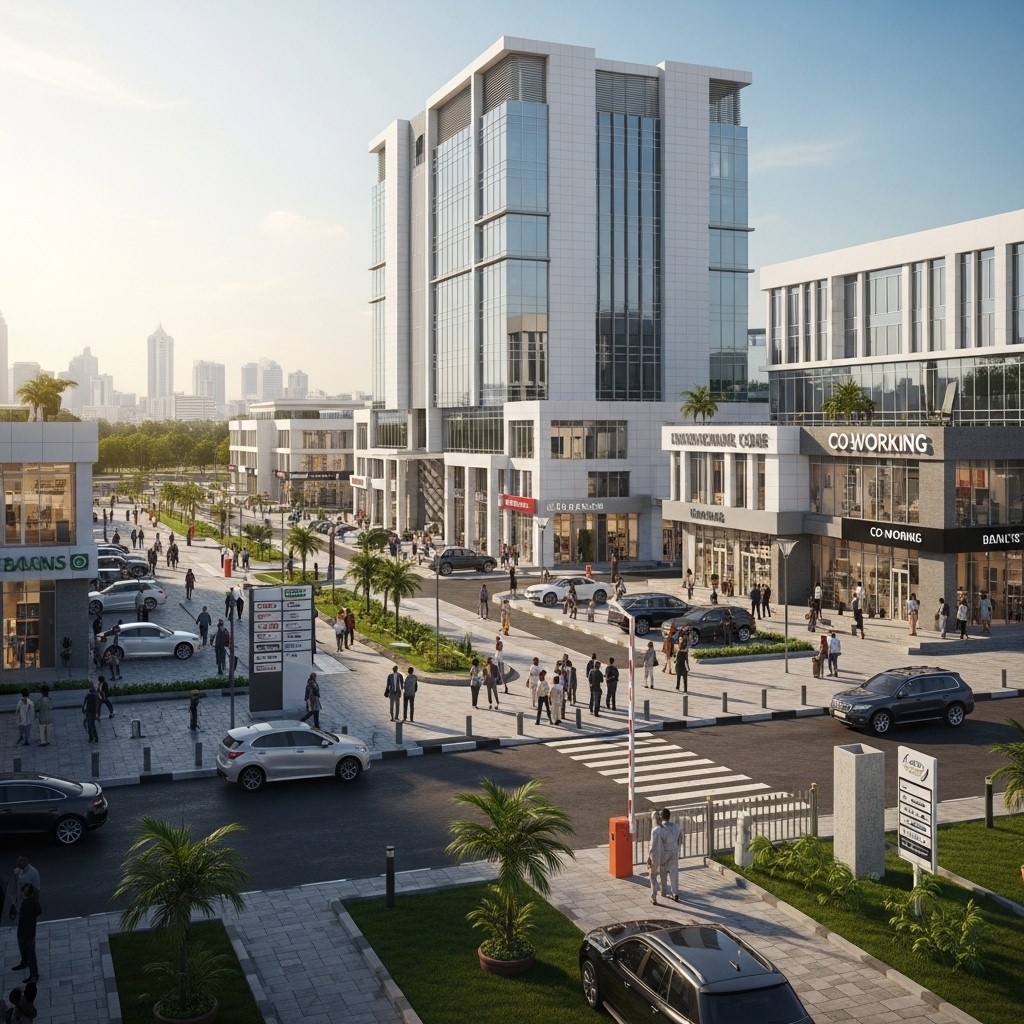
What Is Commercial Real Estate
BY: Landnest Homes And Properties
Monday, February 2, 2026
February 2, 2026


The Backbone of the Economy You Rarely Notice
Every time you walk into a bank, a supermarket, a salon, or even a private school, you’re standing inside commercial real estate.
Behind every rented office, every bustling plaza, every logistics hub is an ecosystem of ownership, leasing, and investment that drives jobs, income, and urban development.
Yet, despite its visibility, many Nigerians still see real estate as only residential land to build homes, not businesses.
That’s a missed opportunity.
Commercial real estate, or CRE, is where everyday transactions meet long-term growth. It’s what powers a city’s rhythm, from Ibadan to Lagos, Port Harcourt, and Abuja.
And as Nigeria’s cities evolve, CRE is no longer reserved for big corporations or billion-naira investors. It’s now open to smaller, smarter, and more strategic investors who understand that profit lives where people and business intersect.
What Exactly Is Commercial Real Estate?
At its core, Commercial Real Estate (CRE) refers to properties used primarily for business or income-generating purposes, not personal residence.
It includes:
Office buildings
Retail outlets and malls
Warehouses and logistics centers
Hotels and short-let apartments
Mixed-use developments that combine residential, retail, and office spaces
If a property produces rent or supports commerce, it falls under the umbrella of commercial real estate.
In simple terms:
Residential real estate provides shelter.
Commercial real estate provides opportunity.
The Backbone of the Economy You Rarely Notice
Every time you walk into a bank, a supermarket, a salon, or even a private school, you’re standing inside commercial real estate.
Behind every rented office, every bustling plaza, every logistics hub is an ecosystem of ownership, leasing, and investment that drives jobs, income, and urban development.
Yet, despite its visibility, many Nigerians still see real estate as only residential land to build homes, not businesses.
That’s a missed opportunity.
Commercial real estate, or CRE, is where everyday transactions meet long-term growth. It’s what powers a city’s rhythm, from Ibadan to Lagos, Port Harcourt, and Abuja.
And as Nigeria’s cities evolve, CRE is no longer reserved for big corporations or billion-naira investors. It’s now open to smaller, smarter, and more strategic investors who understand that profit lives where people and business intersect.
What Exactly Is Commercial Real Estate?
At its core, Commercial Real Estate (CRE) refers to properties used primarily for business or income-generating purposes, not personal residence.
It includes:
Office buildings
Retail outlets and malls
Warehouses and logistics centers
Hotels and short-let apartments
Mixed-use developments that combine residential, retail, and office spaces
If a property produces rent or supports commerce, it falls under the umbrella of commercial real estate.
In simple terms:
Residential real estate provides shelter.
Commercial real estate provides opportunity.
The Main Types of Commercial Real Estate
Though CRE takes many forms, it generally falls into five major categories:
1. Office Spaces
These range from small business suites to high-rise corporate towers. In cities like Ibadan and Lagos, demand for modern office spaces is driven by tech startups, law firms, banks, and logistics companies.
Offices generate steady income through long-term leases. Their value depends on location, accessibility, and maintenance quality.
2. Retail Properties
Markets, shopping complexes, supermarkets, and stores fall into this category. Retail spaces remain some of the most profitable commercial properties because they benefit directly from population density and spending.
In Ibadan, plazas around Bodija, Challenge, and Ring Road have experienced consistent appreciation due to steady foot traffic.
3. Industrial and Logistics Facilities
Warehouses, factories, and storage units support the flow of goods and materials.
As Nigeria embraces e-commerce and manufacturing, demand for industrial spaces in accessible corridors like Oluyole Industrial Estate and Moniya has grown sharply.
4. Hospitality and Short-Stay Properties
Hotels, lodges, and serviced apartments serve business travelers and tourists.
The short-let segment, particularly in Lagos, Ibadan, and Abuja, has created a profitable sub-market for investors who manage property through digital platforms.
5. Mixed-Use Developments
These developments blend residential, commercial, and leisure spaces like a mini city.
They allow investors to diversify income streams while offering convenience to occupants.
How Commercial Real Estate Generates Income
Commercial real estate is primarily an income-producing asset. There are three major ways investors earn:
Rental Income
Businesses pay rent for using commercial spaces. The more desirable the location, the higher the rental value.Capital Appreciation
Over time, the property’s value rises due to improvements, infrastructure growth, or market demand.Development Returns
Developers buy undeveloped land, build commercial properties, and sell or lease them for profit.
When structured properly, CRE produces steady cash flow, hedge against inflation, and tangible long-term assets.
The Main Types of Commercial Real Estate
Though CRE takes many forms, it generally falls into five major categories:
1. Office Spaces
These range from small business suites to high-rise corporate towers. In cities like Ibadan and Lagos, demand for modern office spaces is driven by tech startups, law firms, banks, and logistics companies.
Offices generate steady income through long-term leases. Their value depends on location, accessibility, and maintenance quality.
2. Retail Properties
Markets, shopping complexes, supermarkets, and stores fall into this category. Retail spaces remain some of the most profitable commercial properties because they benefit directly from population density and spending.
In Ibadan, plazas around Bodija, Challenge, and Ring Road have experienced consistent appreciation due to steady foot traffic.
3. Industrial and Logistics Facilities
Warehouses, factories, and storage units support the flow of goods and materials.
As Nigeria embraces e-commerce and manufacturing, demand for industrial spaces in accessible corridors like Oluyole Industrial Estate and Moniya has grown sharply.
4. Hospitality and Short-Stay Properties
Hotels, lodges, and serviced apartments serve business travelers and tourists.
The short-let segment, particularly in Lagos, Ibadan, and Abuja, has created a profitable sub-market for investors who manage property through digital platforms.
5. Mixed-Use Developments
These developments blend residential, commercial, and leisure spaces like a mini city.
They allow investors to diversify income streams while offering convenience to occupants.
How Commercial Real Estate Generates Income
Commercial real estate is primarily an income-producing asset. There are three major ways investors earn:
Rental Income
Businesses pay rent for using commercial spaces. The more desirable the location, the higher the rental value.Capital Appreciation
Over time, the property’s value rises due to improvements, infrastructure growth, or market demand.Development Returns
Developers buy undeveloped land, build commercial properties, and sell or lease them for profit.
When structured properly, CRE produces steady cash flow, hedge against inflation, and tangible long-term assets.
Key Differences Between Residential and Commercial Real Estate
Feature | Residential | Commercial |
Purpose | Personal housing | Business or income generation |
Income Source | Rent from individuals | Rent from companies or traders |
Lease Duration | Usually 1–2 years | Often 3–10 years |
Risk Level | Moderate | Higher but with greater returns |
Maintenance | Managed by landlord | Often handled by tenants or property managers |
Appreciation | Gradual | Can spike rapidly with area development |
The major takeaway: commercial real estate carries higher upfront cost and complexity, but it compensates with stability and higher earning potential.
Key Differences Between Residential and Commercial Real Estate
Feature | Residential | Commercial |
Purpose | Personal housing | Business or income generation |
Income Source | Rent from individuals | Rent from companies or traders |
Lease Duration | Usually 1–2 years | Often 3–10 years |
Risk Level | Moderate | Higher but with greater returns |
Maintenance | Managed by landlord | Often handled by tenants or property managers |
Appreciation | Gradual | Can spike rapidly with area development |
The major takeaway: commercial real estate carries higher upfront cost and complexity, but it compensates with stability and higher earning potential.
Why Commercial Real Estate Is Gaining Ground in Nigeria
Nigeria’s economic structure is changing. The country’s growth is being driven not only by oil but also by commerce, manufacturing, logistics, and services.
This shift has created huge demand for structured commercial spaces.
1. Urbanization and Population Growth
As more people move to cities, the need for organized business environments rises.
2. The E-Commerce Boom
Online shopping platforms require warehouses, fulfillment centers, and pick-up hubs.
3. Government Infrastructure Expansion
Projects like the Lagos-Ibadan Expressway, Ibadan Inland Dry Port, and Lekki Deep Seaport are opening up new corridors for commerce.
4. The Informal Sector’s Transformation
Traditional traders are moving into formal, planned markets and shops for security, documentation, and long-term ownership.
5. Diaspora Investment
Many Nigerians abroad prefer commercial real estate for its clear income stream and documentation security.
Why Commercial Real Estate Is Gaining Ground in Nigeria
Nigeria’s economic structure is changing. The country’s growth is being driven not only by oil but also by commerce, manufacturing, logistics, and services.
This shift has created huge demand for structured commercial spaces.
1. Urbanization and Population Growth
As more people move to cities, the need for organized business environments rises.
2. The E-Commerce Boom
Online shopping platforms require warehouses, fulfillment centers, and pick-up hubs.
3. Government Infrastructure Expansion
Projects like the Lagos-Ibadan Expressway, Ibadan Inland Dry Port, and Lekki Deep Seaport are opening up new corridors for commerce.
4. The Informal Sector’s Transformation
Traditional traders are moving into formal, planned markets and shops for security, documentation, and long-term ownership.
5. Diaspora Investment
Many Nigerians abroad prefer commercial real estate for its clear income stream and documentation security.
What Determines the Value of a Commercial Property
Just like residential real estate, commercial property value depends on measurable and perceptual factors:
Location and accessibility — proximity to major roads, markets, or business districts
Occupancy rate — higher demand means higher income potential
Tenant profile — strong, reputable tenants increase stability
Infrastructure — electricity, drainage, parking, and security
Zoning laws — determine what kind of business activity can operate there
Lease terms and rent control — affect revenue predictability
A prime example: properties near Challenge or Ring Road in Ibadan can yield double-digit rental returns because they combine accessibility, visibility, and consistent demand.
The Risks of Commercial Real Estate
No investment is without risk. The key is managing them intelligently.
Vacancy Risk:
Businesses may move or shut down, leaving spaces unoccupied.
Mitigation: Choose locations with diverse business demand.Economic Fluctuations:
Inflation, currency shifts, or policy changes can affect rent stability.
Mitigation: Index leases to inflation or negotiate flexible terms.High Initial Cost:
Commercial developments require substantial capital.
Mitigation: Partner with trusted developers or engage in co-ownership.Management Complexity:
Commercial tenants demand maintenance, utilities, and facility management.
Mitigation: Employ professional managers or outsource operations.
How Investors Can Get Started in Commercial Real Estate
You don’t have to own a skyscraper to join the commercial market.
Here are entry points that fit different budgets:
Buy a Shop or Stall in an Estate Market
Affordable options like the upcoming Oluyole Ultra-Modern Market in Ibadan allow small investors to secure documented, income-generating spaces.Invest in Co-Ownership or Group Buying
Pooling funds with others to buy larger commercial plots or plazas reduces risk and cost.Acquire Land in Commercial Corridors
Strategic plots in developing areas like Moniya, Egbeda, and Apata can be held for appreciation or future development.Partner with Developers
Investors can finance a portion of a commercial project and share profits after completion.Buy and Lease Mixed-Use Spaces
Short-let apartments with retail spaces on the ground floor offer dual income streams.
Commercial Real Estate in Ibadan: The Next Growth Frontier
Ibadan is evolving fast, and its commercial real estate sector is quietly booming.
1. Infrastructure Advantage
The Lagos-Ibadan Expressway, new bypasses, and improved roads have positioned Ibadan as a regional logistics hub.
2. Industrial Expansion
Oluyole Industrial Estate and the new Dry Port at Moniya are drawing investors seeking warehouse and distribution spaces.
3. Affordable Entry Point
Compared to Lagos, land and development costs in Ibadan remain accessible — allowing investors to earn strong returns at lower capital.
4. Estate-Backed Commercial Projects
Landnest’s upcoming commercial zones within residential estates give buyers documented, serviced plots ready for shops, plazas, and offices.
Landnest’s Vision: Enabling Everyday Investors to Play Bigger
At Landnest Homes and Properties, we believe commercial real estate shouldn’t be reserved for a select few. It should be a platform for ordinary Nigerians to participate in national growth.
Our focus is on creating structured commercial environments — markets, plazas, and mixed-use communities — that are accessible, affordable, and secure.
We provide:
Documented titles (Registered Surveys, Deed of Assignment)
Flexible payment plans for small business owners
Strategic locations near high-growth industrial corridors
Professional advisory for investors exploring commercial options
By helping individuals transition from residential plots to income-generating properties, Landnest is cultivating the next generation of real estate entrepreneurs.
The Future of Commercial Real Estate in Nigeria
Nigeria’s commercial landscape is shifting toward formalization and digitalization.
Expect to see:
Digitally managed markets and plazas using smart leasing systems
Green commercial developments powered by renewable energy
Stronger regulations to protect tenants and investors
Expansion beyond major cities — into growth corridors like Ibadan, Ogun, and Ilorin
The next decade will belong to developers and investors who understand not just land, but enterprise.
Conclusion: The Space Where Enterprise Lives
Commercial real estate is where business meets vision. It’s not just about buildings — it’s about creating environments that power productivity and prosperity.
Every shop, every office, every warehouse you see represents more than commerce. It represents confidence in a city’s future.
For Nigerians looking to build wealth with purpose, commercial real estate offers stability, growth, and legacy.
📞 Send “COMMERCIAL” via WhatsApp today to speak with a Landnest advisor about upcoming investment opportunities in Ibadan’s commercial zones and markets.
Because when you invest in commercial real estate, you’re not just buying property, you’re buying into the heartbeat of tomorrow’s economy.

What Determines the Value of a Commercial Property
Just like residential real estate, commercial property value depends on measurable and perceptual factors:
Location and accessibility — proximity to major roads, markets, or business districts
Occupancy rate — higher demand means higher income potential
Tenant profile — strong, reputable tenants increase stability
Infrastructure — electricity, drainage, parking, and security
Zoning laws — determine what kind of business activity can operate there
Lease terms and rent control — affect revenue predictability
A prime example: properties near Challenge or Ring Road in Ibadan can yield double-digit rental returns because they combine accessibility, visibility, and consistent demand.
The Risks of Commercial Real Estate
No investment is without risk. The key is managing them intelligently.
Vacancy Risk:
Businesses may move or shut down, leaving spaces unoccupied.
Mitigation: Choose locations with diverse business demand.Economic Fluctuations:
Inflation, currency shifts, or policy changes can affect rent stability.
Mitigation: Index leases to inflation or negotiate flexible terms.High Initial Cost:
Commercial developments require substantial capital.
Mitigation: Partner with trusted developers or engage in co-ownership.Management Complexity:
Commercial tenants demand maintenance, utilities, and facility management.
Mitigation: Employ professional managers or outsource operations.
How Investors Can Get Started in Commercial Real Estate
You don’t have to own a skyscraper to join the commercial market.
Here are entry points that fit different budgets:
Buy a Shop or Stall in an Estate Market
Affordable options like the upcoming Oluyole Ultra-Modern Market in Ibadan allow small investors to secure documented, income-generating spaces.Invest in Co-Ownership or Group Buying
Pooling funds with others to buy larger commercial plots or plazas reduces risk and cost.Acquire Land in Commercial Corridors
Strategic plots in developing areas like Moniya, Egbeda, and Apata can be held for appreciation or future development.Partner with Developers
Investors can finance a portion of a commercial project and share profits after completion.Buy and Lease Mixed-Use Spaces
Short-let apartments with retail spaces on the ground floor offer dual income streams.
Commercial Real Estate in Ibadan: The Next Growth Frontier
Ibadan is evolving fast, and its commercial real estate sector is quietly booming.
1. Infrastructure Advantage
The Lagos-Ibadan Expressway, new bypasses, and improved roads have positioned Ibadan as a regional logistics hub.
2. Industrial Expansion
Oluyole Industrial Estate and the new Dry Port at Moniya are drawing investors seeking warehouse and distribution spaces.
3. Affordable Entry Point
Compared to Lagos, land and development costs in Ibadan remain accessible — allowing investors to earn strong returns at lower capital.
4. Estate-Backed Commercial Projects
Landnest’s upcoming commercial zones within residential estates give buyers documented, serviced plots ready for shops, plazas, and offices.
Landnest’s Vision: Enabling Everyday Investors to Play Bigger
At Landnest Homes and Properties, we believe commercial real estate shouldn’t be reserved for a select few. It should be a platform for ordinary Nigerians to participate in national growth.
Our focus is on creating structured commercial environments — markets, plazas, and mixed-use communities — that are accessible, affordable, and secure.
We provide:
Documented titles (Registered Surveys, Deed of Assignment)
Flexible payment plans for small business owners
Strategic locations near high-growth industrial corridors
Professional advisory for investors exploring commercial options
By helping individuals transition from residential plots to income-generating properties, Landnest is cultivating the next generation of real estate entrepreneurs.
The Future of Commercial Real Estate in Nigeria
Nigeria’s commercial landscape is shifting toward formalization and digitalization.
Expect to see:
Digitally managed markets and plazas using smart leasing systems
Green commercial developments powered by renewable energy
Stronger regulations to protect tenants and investors
Expansion beyond major cities — into growth corridors like Ibadan, Ogun, and Ilorin
The next decade will belong to developers and investors who understand not just land, but enterprise.
Conclusion: The Space Where Enterprise Lives
Commercial real estate is where business meets vision. It’s not just about buildings — it’s about creating environments that power productivity and prosperity.
Every shop, every office, every warehouse you see represents more than commerce. It represents confidence in a city’s future.
For Nigerians looking to build wealth with purpose, commercial real estate offers stability, growth, and legacy.
📞 Send “COMMERCIAL” via WhatsApp today to speak with a Landnest advisor about upcoming investment opportunities in Ibadan’s commercial zones and markets.
Because when you invest in commercial real estate, you’re not just buying property, you’re buying into the heartbeat of tomorrow’s economy.

Comments
Comments
LET’S GET IN TOUCH
The Ultimate Real Estate Investment Provider
Discover the unthinkable return of investment on real estate. We are committed to making this journey a seamless experience for you.


Visit Us at
Head Office:
No 2, Dele Adetoro Street, Bodija Ibadan.
Branch Office:
Suite 101 Block C, Akord Shopping Mall, Along Lekki_Epe, Expressway Bogije, Ibeju-Lekki, Lagos State.

EFCC via its Special Control Unit Money Laundering (SCUML)

We are also accredited by the Real Estate Developers Association of Nigeria (REDAN)

Registered with Corporate Affairs Commission, Nigeria (RC:7080017)
© LandNest Homes & Properties. 2024.
LET’S GET IN TOUCH
The Ultimate Real Estate Investment Provider
Discover the unthinkable return of investment on real estate. We are committed to making this journey a seamless experience for you.


Visit Us at
Head Office:
No 2, Dele Adetoro Street, Bodija Ibadan.
Branch Office:
Suite 101 Block C, Akord Shopping Mall, Along Lekki_Epe, Expressway Bogije, Ibeju-Lekki, Lagos State.

Registered under EFCC via its Special Control Unit Money Laundering (SCUML)

We are also accredited by the Real Estate Developers Association of Nigeria (REDAN)

Registered with Corporate Affairs Commission, Nigeria (RC:7080017)
© LandNest Homes & Properties. 2024.
LET’S GET IN TOUCH
The Ultimate Real Estate Investment Provider
Discover the unthinkable return of investment on real estate. We are committed to making this journey a seamless experience for you.


Visit Us at
Head Office:
No 2, Dele Adetoro Street, Bodija Ibadan.
Branch Office:
Suite 101 Block C, Akord Shopping Mall, Along Lekki_Epe, Expressway Bogije, Ibeju-Lekki, Lagos State.

EFCC via its Special Control Unit Money Laundering (SCUML)

We are also accredited by the Real Estate Developers Association of Nigeria (REDAN)

Registered with Corporate Affairs Commission, Nigeria (RC:7080017)
© LandNest Homes & Properties. 2024.
LET’S GET IN TOUCH
The Ultimate Real Estate Investment Provider
Discover the unthinkable return of investment on real estate. We are committed to making this journey a seamless experience for you.


Visit Us at
Head Office:
No 2, Dele Adetoro Street, Bodija Ibadan.
Branch Office:
Suite 101 Block C, Akord Shopping Mall, Along Lekki_Epe, Expressway Bogije, Ibeju-Lekki, Lagos State.

EFCC via its Special Control Unit Money Laundering (SCUML)

We are also accredited by the Real Estate Developers Association of Nigeria (REDAN)

Registered with Corporate Affairs Commission, Nigeria (RC:7080017)
© LandNest Homes & Properties. 2024.